The Unshakeable Empire of Self-Praise: Trump\'s State of the Union and the Persistent Narrative of Unparalleled Victory
The Grand Hall of American Rhetoric Echoed with Triumph, Yet the Shadows of Electoral Reality Lingered.
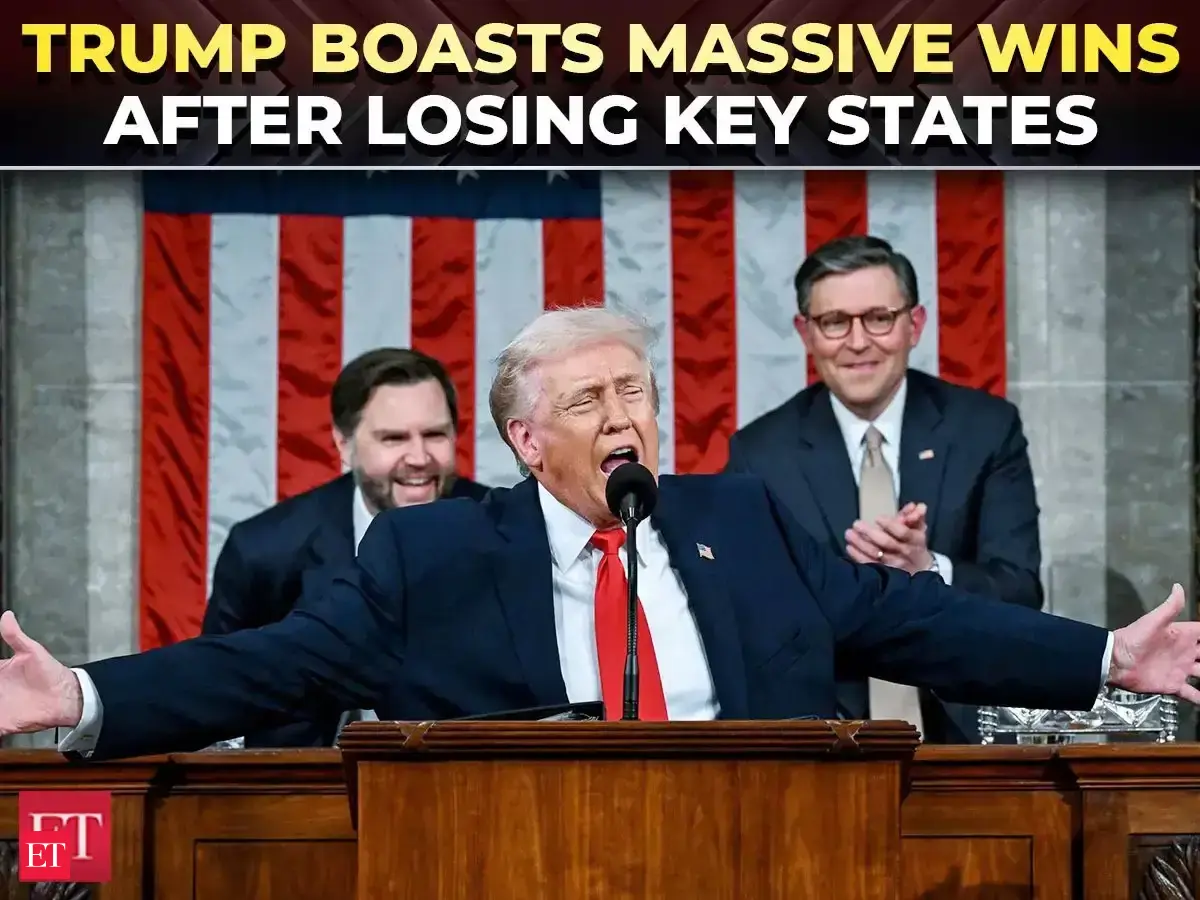
In a powerful display of political theater, President Donald Trump delivered a State of the Union address that was less a report on the nation\'s condition and more a meticulously crafted testament to his own perceived triumphs. Standing before a divided Congress and a nation wrestling with complex challenges, Trump painted a portrait of an America revitalized, a land reborn under his leadership. He declared, with a characteristic flourish, \"America can\'t handle my wins.\" This bold assertion, reverberating through the hallowed halls of Washington D.C., stood in stark contrast to the nuanced realities of a nation grappling with economic inequalities, shifting geopolitical landscapes, and an increasingly polarized electorate. While the President extolled the virtues of his administration\'s achievements, a deeper examination of the facts and the underlying currents of American society reveals a more intricate narrative, one where the boasting of victories often overshadows the complex tapestry of actual progress and persistent challenges.
The Echo Chamber of Accomplishment: A President\'s Portrait of Prosperity
The State of the Union address, a constitutionally mandated ritual, has long served as a platform for presidents to communicate their vision, policy priorities, and a summative report card on their time in office. For Donald Trump, however, this annual address often transcends mere reporting, morphing into a grand stage for self-congratulation and a robust defense of his presidency against a barrage of criticism and scrutiny. On this particular occasion, the President\'s words were laced with an almost defiant pride, a declaration that the nation was experiencing an unprecedented era of success, and that his administration was the sole architect of this miraculous turnaround.
The economic narrative was central to Trump\'s address. He pointed to robust job growth, citing record low unemployment rates, particularly for minority groups. The stock market’s ascent was frequently invoked as a tangible symbol of American prosperity, a barometer of the nation’s economic health directly attributable to his policies. He lauded tax cuts, deregulation, and a renegotiated trade landscape as the cornerstones of this economic renaissance, promising continued prosperity and a brighter future for all Americans.
Beyond the economy, Trump trumpeted advancements in national security and foreign policy. He highlighted the defeat of ISIS, the rebuilding of the military, and a more assertive stance on the global stage. He spoke of peace deals, the protection of borders, and a renewed sense of American exceptionalism that, in his telling, had been lost before his arrival. Domestic policy achievements, from criminal justice reform to appointments of conservative judges, were also presented as significant victories, shaping the nation\'s legal and social fabric for generations to come.
The language employed was deliberately designed to resonate with his base and to project an image of unassailable strength and effectiveness. The phrase \"America can\'t handle my wins\" was not merely a boast; it was a strategic declaration, a framing device intended to suggest that the sheer magnitude of his accomplishments was so overwhelming that it defied easy comprehension or acceptance by those who opposed him. It was a challenge, a taunt, and a rallying cry all rolled into one, designed to solidify his image as a uniquely successful leader.
Beyond the Rhetoric: Deconstructing the \"Wins\" in Key States and Beyond
While the President painted a picture of universal triumph, a dispassionate analysis of the electoral map and a deeper dive into the underlying economic and social indicators reveal a more complex and, for some, less celebratory reality. The very phrase \"America can\'t handle my wins\" carries an implicit understanding that there are those who *would* prefer not to acknowledge these wins. This sentiment, while potent on the campaign trail, often struggles to hold up under the weight of objective data, particularly when examining the crucial swing states that have historically determined presidential elections.
The description of the State of the Union address specifically mentions the President boasting of his wins \"despite losing in key states.\" This seemingly contradictory statement is at the heart of understanding the Trumpian political phenomenon. It suggests a deliberate strategy of focusing on broad, often generalized, narratives of success while downplaying or reframing specific electoral setbacks. This approach seeks to maintain momentum and project an image of dominance, even when faced with tangible evidence to the contrary.
To truly understand the significance of this juxtaposition, it’s crucial to delve into the context of the American political landscape and the specific metrics that define national success.
The Economic Narrative: A Tale of Two Americas?
President Trump frequently cited a booming economy as his crowning achievement. The statistics often presented – low unemployment, rising GDP – are indeed impressive on their face. However, a closer look reveals a more nuanced picture, particularly when considering the distribution of these gains and the long-term sustainability of the economic policies enacted.
* Job Creation: While headline unemployment figures were low, it’s important to examine the *types* of jobs being created and the wage growth associated with them. Many of the jobs added were in sectors that have historically offered lower wages and fewer benefits. Furthermore, while unemployment rates for certain demographic groups reached historic lows, this was a trend that had been in motion for several years prior to Trump\'s presidency, a continuation of an Obama-era recovery.
* Tax Cuts and Inequality: The Tax Cuts and Jobs Act of 2017 was a cornerstone of Trump\'s economic agenda. While proponents argued it would stimulate business investment and job growth, critics pointed to its disproportionate benefit to corporations and wealthy individuals, potentially exacerbating income inequality. The long-term impact of these tax cuts on the national debt also remains a significant concern.
* Trade Wars and Tariffs: Trump\'s aggressive stance on trade, characterized by tariffs on goods from China and other nations, was presented as a victory for American workers and industries. However, these policies also led to increased costs for American consumers and retaliatory tariffs that harmed American exporters, particularly in the agricultural sector. Key agricultural states, often crucial in presidential elections, felt the sting of these trade disputes.
* Manufacturing Renaissance? The narrative of bringing back manufacturing jobs was a central theme. While there were some gains in manufacturing employment, the overall trend of manufacturing job losses due to automation and globalization predated Trump and continued to be a significant challenge. The \"wins\" in this sector were often debated in terms of their scale and their lasting impact.
Geopolitical Shifts and Perceived National Security Triumphs
Trump\'s foreign policy was characterized by an \"America First\" approach, a departure from traditional multilateralism. His administration sought to renegotiate international agreements, challenge existing alliances, and assert a more unilateral American presence on the global stage.
* The \"Deal of the Century\" and Middle East Policy: Trump\'s administration pursued a distinct approach to the Israeli-Palestinian conflict, culminating in the Abraham Accords, which normalized relations between Israel and several Arab nations. While hailed as a diplomatic breakthrough by some, the ultimate resolution of the core conflict remained elusive, and critics questioned the long-term implications for regional stability.
* Challenging Existing Alliances: Trump frequently questioned the value of NATO and other long-standing alliances, demanding greater financial contributions from allies. This rhetoric, while intended to pressure allies, also sowed seeds of doubt about American commitment and potentially emboldened adversaries.
* \"America First\" and Global Standing: The emphasis on national interest above all else led to a reevaluation of America\'s role in international institutions and global governance. While this resonated with a segment of the electorate, it also led to concerns about a decline in American influence and a weakening of the international order.
The Electoral Reality: The Importance of Key States
The President\'s declaration that \"America can\'t handle my wins\" takes on a particular resonance when considering the electoral map, especially in the context of presidential elections. The United States, with its Electoral College system, often hinges on the outcomes in a handful of swing states. These are the states where voter sentiment can be swayed by a few thousand votes, and where a president\'s perceived successes or failures can have a direct and tangible impact on their ability to secure a second term.
* The Battleground States: States like Pennsylvania, Michigan, Wisconsin, Ohio, Florida, Arizona, and North Carolina have consistently been the focus of presidential campaigns. The outcomes in these states are often determined by a complex interplay of economic conditions, demographic shifts, and the effectiveness of campaign messaging.
* The Disconnect: The disconnect between the President\'s broad claims of victory and the actual electoral outcomes in these crucial states highlights a key aspect of his political strategy. While he could point to national economic indicators or foreign policy actions as \"wins,\" voters in these key states may have experienced different realities. For example, a farmer in Iowa might have felt the negative impact of trade tariffs, or a factory worker in Michigan might not have seen a direct benefit from deregulation.
* The Power of Perception vs. Reality: Trump\'s ability to project an image of consistent victory, even in the face of electoral challenges, is a testament to his mastery of communication and his understanding of his base. He masterfully framed narratives in a way that resonated with his supporters, often casting any opposition or negative news as biased or \"fake.\" This allowed him to maintain a strong sense of momentum and to project an aura of invincibility, which is a powerful tool in politics.
The Stakeholders in the Symphony of Success and Scrutiny
The State of the Union address, and indeed the entire presidency, involves a complex web of stakeholders, each with their own interests, perspectives, and reactions to the President\'s pronouncements. Understanding these different groups is crucial to a comprehensive analysis of the \"wins\" being celebrated.
* The President and His Administration: For President Trump and his inner circle, the State of the Union is a critical opportunity to frame the narrative, rally supporters, and solidify their legacy. The emphasis on \"wins\" is a defensive strategy, aimed at countering criticism and bolstering their political standing. They are the conductors of this symphony of self-praise, orchestrating the message to maximize its impact.
* The Republican Party: For the Republican Party, the President\'s perceived successes are often seen as vital to their own electoral fortunes. They are largely aligned with the President\'s message, reinforcing his claims and using them to campaign for congressional seats. However, there can be internal divisions, with some Republicans more keenly aware of the nuances and potential downsides of certain policies.
* The Democratic Party and Opposition: Democrats, by definition, are in opposition and are likely to view the President\'s claims with skepticism or outright rejection. They will focus on the areas where they believe the President has failed, highlighting policies that have exacerbated inequality, damaged the environment, or eroded democratic norms. They are the critical counter-melody in this political opera, offering a different interpretation of events.
* The American Public: This is the broadest and most diverse stakeholder group. The impact of the President\'s policies and his pronouncements varies widely across different segments of the population. Some Americans will wholeheartedly embrace the narrative of unparalleled success, feeling personally uplifted by the economic improvements or the sense of national pride. Others will experience the limitations or negative consequences of these policies, feeling left behind or overlooked. The media plays a crucial role in shaping how this message is received.
* International Allies and Adversaries: On the global stage, President Trump\'s words and actions have significant implications. Allies may view his \"wins\" with cautious optimism or concern, depending on whether they align with their own interests. Adversaries may interpret his assertive rhetoric and policies as opportunities to exploit vulnerabilities or to further their own geopolitical agendas.
A Chronology of Claims: The Evolution of the \"Unprecedented Wins\" Narrative
The State of the Union address is a singular event, but the narrative of \"unprecedented wins\" has been a consistent theme throughout President Trump\'s time in office. To fully grasp the context, it\'s helpful to trace the evolution of this narrative, particularly in relation to key policy initiatives and electoral cycles.
* Early Promises (2017-2018): Following his election, Trump made sweeping promises to revitalize the American economy, bring back manufacturing jobs, and renegotiate trade deals. The passage of the Tax Cuts and Jobs Act in late 2017 was immediately framed as a historic victory, with projections of massive economic growth and job creation. The emphasis was on bold action and a departure from what he termed \"failed policies\" of the past.
* The Trade Wars and Shifting Dynamics (2018-2019): The imposition of tariffs on goods from China and other nations became a central focus. Trump frequently declared that the U.S. was winning these \"trade wars,\" even as economic data showed mixed results and retaliatory tariffs impacted American businesses. The narrative began to shift from universally felt economic gains to a more combative stance, framing these actions as necessary battles for American workers.
* The Midterm Elections and Continued Claims (2018): Despite facing a challenging midterm election cycle where Democrats gained control of the House of Representatives, Trump continued to highlight economic achievements. He often attributed any Democratic gains to factors other than his policies, reinforcing the idea that his administration was on the right track and that any resistance was politically motivated.
* The Pandemic and Economic Disruption (2020): The onset of the COVID-19 pandemic dramatically altered the economic landscape, leading to widespread job losses and economic contraction. In the face of this unprecedented crisis, Trump\'s administration often sought to downplay the severity of the virus and to emphasize the resilience of the American economy, framing the initial economic downturn as a temporary setback. The narrative of continuous wins became more challenging to sustain, leading to a greater focus on blaming external factors or projecting a swift recovery.
* The 2020 Election and the Disputed Outcome: The 2020 presidential election saw Donald Trump lose to Joe Biden. This outcome directly contradicted the narrative of universally acknowledged \"wins\" that the President had so consistently promoted. Despite this, he continued to assert that the election was fraudulent and that he had, in fact, won by a landslide, demonstrating a remarkable ability to maintain his narrative in the face of definitive electoral defeat. The State of the Union address, when delivered after this election, would have been delivered in a unique context, potentially amplified by his ongoing claims of a stolen victory.
The Future Outlook: The Enduring Impact of a Self-Referential Narrative
The State of the Union address, with its grand pronouncements of victory, is more than just a single speech; it is a window into a broader political strategy and a continuing narrative. The implications of President Trump\'s \"America can\'t handle my wins\" rhetoric extend far beyond the immediate political theater.
* The Erosion of Trust in Institutions: When a leader consistently frames reality through the lens of personal triumph, it can create a disconnect between the electorate and objective facts. This can lead to a weakening of trust in traditional sources of information, such as the media and government institutions, as they may be perceived as biased or as attempting to undermine the President\'s narrative.
* The Polarization of the Electorate: The \"us vs. them\" mentality inherent in framing achievements as something \"America can\'t handle\" further entrenches political polarization. It creates a clear division between those who believe in the President\'s vision and those who do not, making it more difficult to find common ground and engage in productive political discourse.
* The Legacy of Economic Policy: The long-term consequences of the economic policies enacted during the Trump administration, such as tax cuts and trade disputes, will continue to be debated and felt for years to come. The \"wins\" celebrated may come with hidden costs, such as increased national debt or altered global trade dynamics, that will require future administrations to address.
* The Evolving Definition of \"Victory\": President Trump\'s presidency has undoubtedly influenced the way political \"wins\" are defined and communicated. The emphasis on strongman leadership, direct communication (often through social media), and a willingness to challenge established norms have become central to his political brand. This may shape how future leaders campaign and govern.
* The Enduring Power of Narrative: Regardless of the objective realities, the power of a compelling narrative cannot be underestimated in politics. Donald Trump\'s ability to consistently project an image of success, even in the face of setbacks, demonstrates the enduring influence of storytelling and persuasive rhetoric in shaping public perception. The question for the future is whether this narrative can be sustained and whether it ultimately serves the long-term interests of the nation.
Conclusion: The Echoes of Victory in a Fractured Landscape
President Donald Trump\'s declaration, \"America can\'t handle my wins,\" delivered during a State of the Union address that was a marathon of self-congratulation, encapsulates a core element of his political persona and his presidency. It is a statement that speaks to a deep-seated belief in his own unparalleled success, a narrative he meticulously crafted and relentlessly promoted. He pointed to economic growth, job creation, and foreign policy achievements as irrefutable evidence of America\'s resurgence under his leadership.
Yet, as the echoes of his words faded in the grand hall, a more complex reality persisted. The very notion of \"wins\" becomes subject to rigorous scrutiny when juxtaposed with the electoral outcomes in key states, the distribution of economic prosperity, and the nuanced realities of a globalized world. The description itself hints at this tension, acknowledging the President\'s boasts despite electoral losses in crucial battlegrounds.
This disconnect highlights a fundamental aspect of contemporary American politics: the profound influence of perception and narrative, often amplified by a fractured media landscape and a deeply polarized electorate. The stakeholders involved – from the President and his party to opposition forces and the broad spectrum of the American public – each interpret these \"wins\" through their own lenses, shaped by their political affiliations, economic circumstances, and fundamental beliefs.
The legacy of this era will undoubtedly be a subject of intense historical debate. Will the celebrated economic indicators translate into lasting prosperity for all Americans? Will the assertive foreign policy decisions foster long-term stability or sow seeds of future conflict? The question of whether America, as a nation, can indeed \"handle\" these proclaimed victories, and what the ultimate cost or benefit of such a perception might be, will continue to unfold long after the applause has died down and the speeches have been filed away. The narrative of unshakeable self-praise, while a powerful political tool, is a complex tapestry woven with threads of genuine accomplishment, selective emphasis, and the persistent challenge of reconciling bold declarations with the intricate realities of governance and the diverse experiences of the American people.