
Politics
धरना-प्रदर्शनों का नया कारोबार: लोकतंत्र की आड़ में आखिर किसके हित साधे जा रहे हैं?
October 10, 2026
1,612 views
Quote of the day: What Karl Marx meant when he said \'Reason has always existed, but...\'
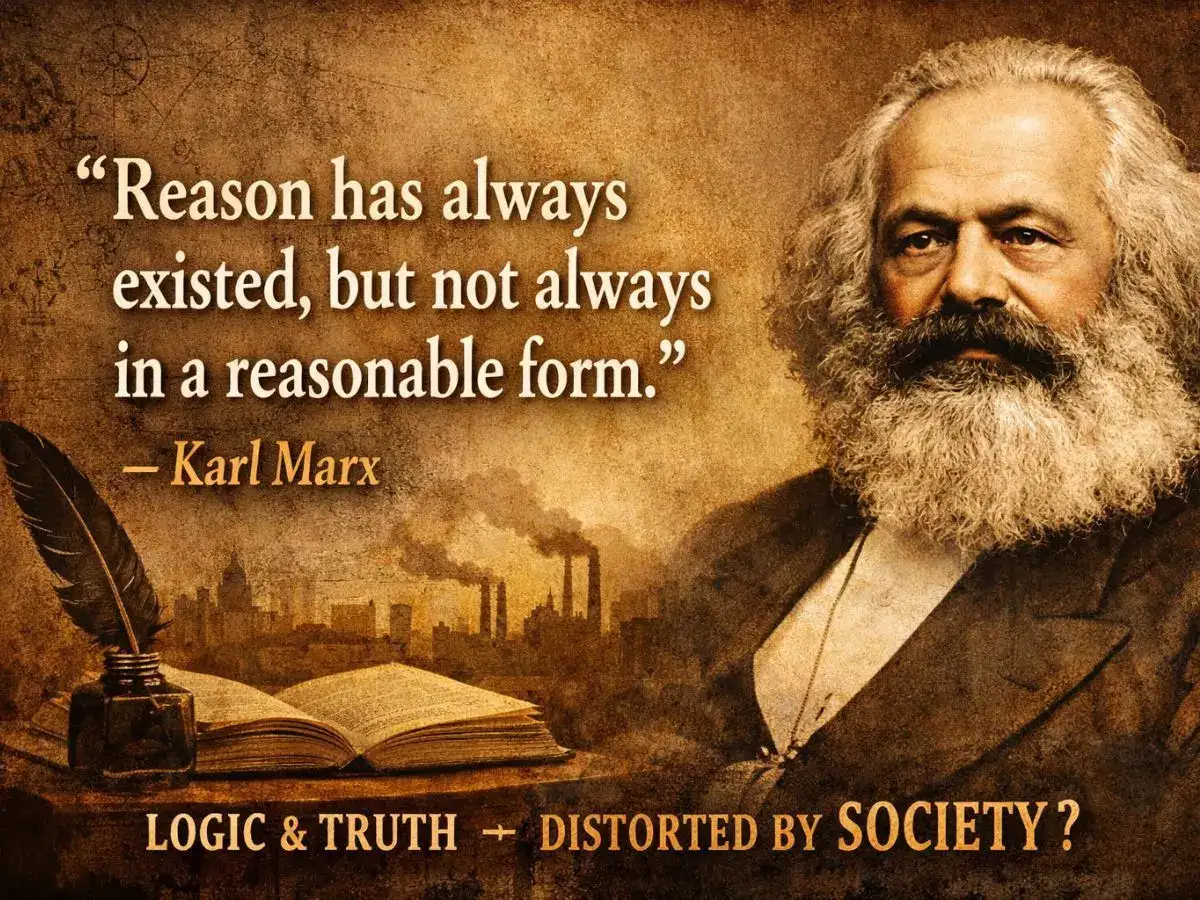
In a world increasingly shaped by complex societal structures and technological advancements, the wisdom of historical figures remains strikingly relevant. One such figure, Karl Marx, offers a profound observation that resonates across centuries: "Reason exists but not always reasonably." This simple yet powerful statement serves as a reminder that while humans possess the capacity for logical thought, the frameworks within which we operate can distort this rationality, leading to outcomes that are often unjust.
Marx, a 19th-century philosopher and economist, dedicated his life to unraveling the intricacies of capitalism and class struggle. His assertion regarding reason highlights a critical aspect of human existence: the dichotomy between rational thought and the irrationality often observed in societal systems. Marx believed that while individuals may harbor logical intentions, the institutionalized structures of society can warp these intentions, resulting in inequities and oppression.
Take, for instance, the modern workplace. Despite intentions of fairness and equality, systemic issues such as discrimination and inequality often undermine these goals. Here, Marx’s observation rings true; the reasoning behind policies might be sound, yet the application can yield results that are anything but reasonable. This disconnect calls for a critical examination of how societal structures influence our reasoning and the decisions we make.
The quote from Marx encourages us to engage in a critical analysis of how ideas are implemented within our societies. It is not enough to merely advocate for rational policies; we must also scrutinize the frameworks that govern them. For instance, in discussions surrounding social justice, it is essential to recognize that well-intentioned laws and regulations can inadvertently perpetuate existing inequalities if they are not thoughtfully designed and executed.
As we navigate contemporary issues such as climate change, economic disparity, and technological disruption, the need for a rigorous examination of our reasoning becomes increasingly urgent. Are we addressing the root causes of these challenges, or are we merely applying superficial solutions that fail to consider the broader implications? Marx's insights prompt us to dig deeper and question whether our rational intentions align with the outcomes we observe.
To foster a society that genuinely embodies the principles of reason, it is imperative to invest in education that emphasizes critical thinking and ethical reasoning. Education should not only provide knowledge but also encourage individuals to challenge existing paradigms and think independently. This approach aligns with Marx’s belief that human reasoning must be continually refined to adapt to changing societal dynamics.
Incorporating a curriculum that prioritizes critical examination of societal structures can empower future generations to identify and address injustices. By equipping individuals with the tools to analyze and critique the frameworks that shape their lives, we can bridge the gap between reason and its practical application. This transformation is vital for creating a more equitable society where rational intentions lead to fair outcomes.
The rise of social movements worldwide underscores the growing recognition of the importance of reason in addressing societal issues. Movements advocating for racial equality, gender rights, and environmental sustainability are fueled by the desire to rectify the distortions that exist within our systems. These movements serve as a testament to the collective understanding that rational thought must be coupled with action to effect meaningful change.
Marx’s assertion reminds us that the journey toward a more just society is ongoing. As we witness the evolution of social movements, it becomes apparent that reason must continually adapt to the challenges of the times. The intersection of technology, culture, and politics presents both opportunities and obstacles in our quest for fairness, and it is our responsibility to navigate these complexities with discernment.
In conclusion, Karl Marx's observation that "reason exists but not always reasonably" serves as a vital reminder of the need for ongoing scrutiny of our societal structures and their impact on human reasoning. As we strive for progress in various aspects of life, from social justice to environmental responsibility, we must remain vigilant in examining how our intentions translate into actions and outcomes.
Ultimately, the challenge lies in refining our reasoning to align it with the principles of equity and justice. By fostering a culture of critical thinking and encouraging individuals to question and challenge the status quo, we can move toward a society where rational intentions lead to reasonable, fair results. The pursuit of this ideal is not merely an academic exercise; it is a collective responsibility that shapes the future of humanity.


Loading more news...
You've reached the end of our news feed. Check back later for more updates!