
Sports
मुंबई के दो लड़के हुए आमने-सामने... सूर्या पड़े भारी, दो ओवरों में कर दी धागा खोल पिटाई
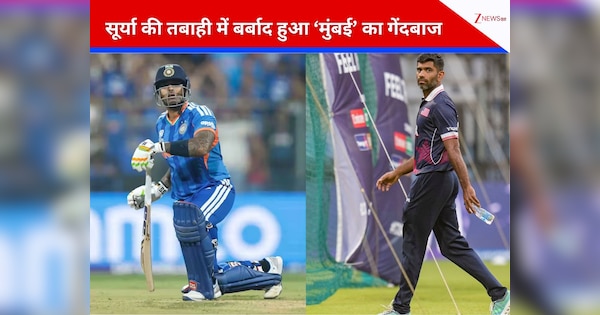
Mumbai\'s Dual: Suryakumar Yadav Dominates, Clinches Victory with Explosive Two-Over Barrage
Introduction
The iconic Wankhede Stadium in Mumbai, a coliseum steeped in cricketing history, was once again the crucible for a thrilling encounter. Amidst the cacophony of passionate Mumbai crowds, two talented cricketers, both with deep roots in the city, found themselves locked in a high-stakes duel. One, a familiar face, a maestro of the unconventional, and the current darling of Indian cricket – Suryakumar Yadav. The other, a relative newcomer on the international stage, but a resident of the same cricketing ecosystem that birthed Yadav\'s brilliance – a talented American bowler familiar with the Wankhede\'s nuances. This narrative unfolds not just as a match report, but as a testament to individual brilliance, strategic resilience, and the captivating drama that unfolds when talent meets opportunity on a grand stage.
The description succinctly captures a pivotal moment that threatened to derail India\'s innings. With the scoreboard reading a precarious 77 and the crucial wicket of Hardik Pandya tumbling, a palpable silence descended upon the Wankhede. Doubts, a rare commodity when India bats, began to creep in, with many fearing the team might struggle to even breach the 120-run mark. It was in this moment of apparent crisis that Suryakumar Yadav, affectionately known as \"SKY,\" stepped up, shouldering the immense responsibility with his characteristic composure and audacious stroke play. He single-handedly steered the Indian ship towards a respectable total of 161, a score that proved to be more than enough to secure victory. The key to this resurgence, as highlighted, was a captivating duel with an American bowler, intimately acquainted with the Wankhede\'s hallowed turf. This article will delve deep into the intricacies of this match, dissecting Suryakumar Yadav\'s extraordinary performance, the tactical battle, and the broader implications of this encounter.
The Early Stumbles: A Cloud of Doubt Over Wankhede
The match commenced under the watchful gaze of a fervent Mumbai crowd, eager to witness their beloved Indian team in action. The initial overs, however, did not unfold as per the script. The American bowling attack, surprisingly disciplined and sharp, managed to apply early pressure. Crucial wickets fell at regular intervals, leaving the Indian batting lineup exposed and vulnerable. The scoreboard, a silent arbiter of the game\'s progress, began to reflect a narrative of struggle.
The dismissal of Hardik Pandya at 77 was a particularly grievous blow. Pandya, a seasoned all-rounder known for his explosive hitting and ability to provide crucial momentum, walking back to the pavilion sent a ripple of concern through the stadium. The Wankhede, usually alive with the roar of the crowd, fell into an unnerving hush. The air was thick with anticipation, but this time it was tinged with apprehension. The thought of not even reaching a defendable total, a cardinal sin in T20 cricket, loomed large. In such dire situations, the onus invariably falls on the shoulders of the team\'s star performers, the players capable of turning the tide with a flick of the wrist or a thunderous drive.
Suryakumar Yadav: The Architect of Resilience
It was in this cauldron of pressure that Suryakumar Yadav, a cricketer who has redefined the art of T20 batting with his innovative strokes and fearless approach, emerged as the sole beacon of hope. He entered the crease with the weight of the nation\'s expectations on his young shoulders, a familiar burden he has learned to carry with remarkable grace. While others faltered, Yadav’s demeanor remained unchanged. He exuded a calm confidence, a silent promise of a fightback.
The initial overs of his innings were a masterclass in calculated aggression. He didn\'t succumb to the pressure of the scoreboard or the dismissals around him. Instead, he focused on building an innings, understanding the rhythm of the game and the capabilities of the opposition. He played the anchor role initially, rotating the strike and punishing the loose deliveries, all the while keeping a keen eye on the required run rate. This patient approach, often overlooked in the rush for quick runs, was the bedrock upon which his later onslaught was built.
As he settled in, the trademark Suryakumar Yadav flair began to unfurl. The unorthodox scoops, the silken pulls, and the audacious drives started to pepper the boundaries. He didn\'t just hit the ball; he seemed to paint the canvas of the Wankhede outfield with his shots. Each boundary was met with a crescendo of cheers, the crowd sensing the shift in momentum, the glimmer of hope rekindled.
The Crucial Two-Over Barrage: A Symphony of Destruction
The narrative of the match, however, truly pivoted during a specific, electrifying two-over spell. This was not just about scoring runs; it was about a strategic dismantling of the opposition\'s bowling attack. It was a period where Suryakumar Yadav transcended from a capable batsman to an unstoppable force, a whirlwind that left the bowlers bewildered and the spectators awestruck.
The description points to a specific American bowler as the focal point of this onslaught, a bowler who possessed intimate knowledge of the Wankhede. This detail adds another layer of intrigue to the narrative. Facing a bowler who understands the conditions, the bounce, and the angles of a particular ground is a challenge in itself. However, Yadav, with his innate ability to read the game and his supreme confidence, seemed unfazed.
This two-over period was a testament to Yadav\'s mental fortitude and his unparalleled shot-making prowess. He didn\'t just target one bowler; he seemed to have identified a weakness, a chink in the armor, and relentlessly exploited it. The shots played were a blend of brute force and exquisite timing. Sixes soared into the stands, clearing the boundary with effortless grace, while fours were driven with surgical precision through gaps in the field.
Each ball faced during this spell was a calculated risk, a gamble that paid off handsomely. He assessed the length, the line, and the pace of the delivery with lightning speed and responded with audacious stroke play. The bowler, presumably a key component of the American strategy, found himself on the receiving end of a relentless barrage. The confidence that might have been built from early wickets was systematically dismantled, replaced by a growing sense of desperation.
The specifics of the deliveries faced and the shots played during these two overs would be etched in the memories of those present. Perhaps it was a perfectly timed flick off the pads that sailed for six over fine leg, a shot that defies conventional cricketing wisdom. Or maybe it was a powerful lofted drive down the ground, a testament to raw power and perfect elevation. It could have been a rasping cut shot, finding the gap with surgical precision, or an audacious scoop shot over the wicketkeeper\'s head, a signature Yadav special. Whatever the specific shots, the result was undeniable: a complete overhaul of the match\'s trajectory.
The impact of this two-over onslaught was immense, not just on the scoreboard but also on the psychological aspect of the game. It injected a much-needed dose of belief back into the Indian camp and demoralized the opposition. The pressure, which had been firmly on India, now shifted decisively. The crowd, which had been silent with worry, erupted into a frenzy of celebration, their faith in their star batsman vindicated.
The American Bowler: A Familiar Foe on Unfamiliar Turf
The mention of an American bowler who \"knows this ground well\" is a crucial piece of information that adds an interesting dimension to the narrative. While the American team might be relatively new to the international cricket scene, the presence of players with prior experience in familiar cricketing venues like Wankhede is a strategic advantage. It suggests that this bowler might have played in Mumbai previously, perhaps in domestic circuits or age-group tournaments.
This familiarity would have translated into a deeper understanding of the Wankhede\'s pitch characteristics: the bounce, the turn (if any), the dimensions of the boundaries, and the general behavior of the wicket under various conditions. This knowledge often allows bowlers to execute their plans with greater precision and confidence. They can anticipate how the ball will react and set their fields accordingly.
However, in this particular encounter, this advantage was rendered ineffective against the sheer brilliance of Suryakumar Yadav. It\'s a classic cricketing adage: even the best-laid plans can be undone by extraordinary individual performance. The bowler, despite his knowledge, was unable to contain Yadav\'s explosive hitting. This highlights the fact that while understanding the conditions is important, the ability to adapt and respond to in-form batsmen is paramount.
It also raises questions about the tactics employed by the American team. Were they too reliant on their bowler\'s knowledge of the Wankhede? Did they have contingency plans for when a batsman like Suryakumar Yadav starts firing? The sustained onslaught suggests a potential lack of adaptability or an underestimation of Yadav\'s capabilities, even by a bowler who supposedly knew the venue well.
The duel between Yadav and this specific bowler during the crucial two-over period becomes a microcosm of the larger contest. It wasn\'t just a bowler trying to dismiss a batsman; it was a test of skills, knowledge, and nerve. And in this instance, Suryakumar Yadav emerged victorious, his mastery of the game trumping any perceived local advantage.
Reaching the 161-Run Mark: A Testament to Yadav\'s Dominance
Following the explosive two-over spell, Suryakumar Yadav continued his impressive display of stroke play. While the intensity might have slightly subsided from the peak of his onslaught, he maintained a high scoring rate, ensuring that India not only recovered from the early setbacks but also posted a formidable total. He paced his innings intelligently, understanding when to accelerate and when to consolidate.
His ability to bat deep into the innings and take the responsibility of scoring the bulk of the runs was instrumental. He didn\'t just rely on boundaries; he also rotated the strike effectively, keeping the scoreboard ticking and preventing the opposition from settling into a rhythm. He showcased a comprehensive batting repertoire, employing both conventional and unconventional shots with equal efficacy.
The final score of 161, which proved to be a match-winning total, was largely a consequence of Suryakumar Yadav\'s extraordinary innings. The description emphasizes that he \"took all the responsibility on his strong shoulders and took India to 161 runs.\" This statement encapsulates the essence of his performance. He was the lynchpin of the Indian batting, the player who single-handedly rescued the team from a precarious position and propelled them towards a winning total.
His ability to perform under pressure, to innovate when necessary, and to remain unfazed by the situation around him is what sets him apart. He has become the epitome of a modern T20 batsman, a player who can adapt to different match scenarios and deliver match-winning performances. His innings at Wankhede was a masterclass in controlled aggression and strategic brilliance.
The Wankhede Factor: Home Advantage and Its Nuances
The Wankhede Stadium, a hallowed ground for Indian cricket, holds a special significance. It\'s a venue where many iconic moments have transpired, and for Indian cricketers, it often carries a sense of familiarity and comfort. The crowds are known for their passionate support, creating an electric atmosphere that can be both exhilarating and intimidating for opposition teams.
For Suryakumar Yadav, being a Mumbai boy, the Wankhede is akin to his backyard. He would have grown up playing on similar pitches, understanding the nuances of the bounce and the dimensions. This familiarity can translate into a psychological advantage, allowing him to play with more freedom and confidence. He knows where to hit the ball to find the boundary and how to exploit the smaller boundaries if they exist.
However, the description also highlights that the American bowler was \"familiar with this ground.\" This suggests a conscious effort by the American team to have players with prior experience in such venues, perhaps acquired during their domestic or league cricket careers. It’s a sign of their growing professionalism and their commitment to understanding the intricacies of playing in different conditions.
The Wankhede pitch itself can also be a factor. Typically, it offers good bounce and carries, making it conducive to stroke play. However, it can also assist spinners later in the game, and dew can become a significant factor during evening matches, making batting easier in the second innings. The fact that India managed to defend their total suggests that either the pitch played its part in assisting the bowlers throughout, or the Indian bowling attack was exceptionally disciplined.
The interplay between the home advantage, the specific characteristics of the Wankhede pitch, and the individual brilliance of Suryakumar Yadav created a compelling narrative for the match. While the crowd support and familiarity might have given India an edge, it was Yadav’s sheer class that ultimately sealed the deal.
Broader Implications and Future Prospects
Suryakumar Yadav\'s performance in this match, especially his decisive innings under pressure, further solidifies his reputation as one of the most impactful T20 batsmen in the world. His ability to consistently deliver match-winning performances, often in challenging situations, makes him an invaluable asset to the Indian cricket team.
His success also serves as an inspiration for aspiring cricketers, particularly those from Mumbai, who dream of achieving similar heights. His journey from local cricket to the international stage is a testament to hard work, dedication, and an unwavering belief in one\'s abilities.
For the American cricket team, this match, despite the loss, would have provided invaluable experience. Playing against a top-tier team like India in a renowned stadium like Wankhede offers a unique learning opportunity. They would have identified areas for improvement in their bowling and fielding, and gained a deeper understanding of the intensity required at the international level. The presence of a bowler familiar with the Wankhede suggests a strategic approach to international cricket, and their continued development will be interesting to watch.
The narrative of two Mumbai boys clashing on the Wankhede stage, with one ultimately emerging triumphant, adds a touch of local flavor and personal rivalry to the global sport of cricket. It underscores the interconnectedness of the cricketing world, where talent can emerge from unexpected corners and familiar faces can be found in diverse sporting landscapes.
Conclusion
The match at the Wankhede Stadium was a compelling spectacle, a testament to the unpredictable nature of cricket and the brilliance of individual talent. While the early stages of the Indian innings were fraught with concern, Suryakumar Yadav rose to the occasion with a performance for the ages. His audacious stroke play, coupled with his astute understanding of the game, transformed a precarious situation into a winning one.
The pivotal two-over spell, where Yadav unleashed a flurry of boundaries, was the defining moment of the match, a symphony of destruction that left the American bowling attack reeling. This innings not only secured victory for India but also etched another glorious chapter in Suryakumar Yadav\'s already illustrious career. The narrative of the Mumbai boy dominating on his home turf, even against a bowler familiar with the stadium\'s secrets, is a story that will resonate with cricket fans for a long time to come. It was a day when individual brilliance shone brightest, illuminating the Wankhede sky and leaving an indelible mark on the annals of T20 cricket.
Introduction
The iconic Wankhede Stadium in Mumbai, a coliseum steeped in cricketing history, was once again the crucible for a thrilling encounter. Amidst the cacophony of passionate Mumbai crowds, two talented cricketers, both with deep roots in the city, found themselves locked in a high-stakes duel. One, a familiar face, a maestro of the unconventional, and the current darling of Indian cricket – Suryakumar Yadav. The other, a relative newcomer on the international stage, but a resident of the same cricketing ecosystem that birthed Yadav\'s brilliance – a talented American bowler familiar with the Wankhede\'s nuances. This narrative unfolds not just as a match report, but as a testament to individual brilliance, strategic resilience, and the captivating drama that unfolds when talent meets opportunity on a grand stage.
The description succinctly captures a pivotal moment that threatened to derail India\'s innings. With the scoreboard reading a precarious 77 and the crucial wicket of Hardik Pandya tumbling, a palpable silence descended upon the Wankhede. Doubts, a rare commodity when India bats, began to creep in, with many fearing the team might struggle to even breach the 120-run mark. It was in this moment of apparent crisis that Suryakumar Yadav, affectionately known as \"SKY,\" stepped up, shouldering the immense responsibility with his characteristic composure and audacious stroke play. He single-handedly steered the Indian ship towards a respectable total of 161, a score that proved to be more than enough to secure victory. The key to this resurgence, as highlighted, was a captivating duel with an American bowler, intimately acquainted with the Wankhede\'s hallowed turf. This article will delve deep into the intricacies of this match, dissecting Suryakumar Yadav\'s extraordinary performance, the tactical battle, and the broader implications of this encounter.
The Early Stumbles: A Cloud of Doubt Over Wankhede
The match commenced under the watchful gaze of a fervent Mumbai crowd, eager to witness their beloved Indian team in action. The initial overs, however, did not unfold as per the script. The American bowling attack, surprisingly disciplined and sharp, managed to apply early pressure. Crucial wickets fell at regular intervals, leaving the Indian batting lineup exposed and vulnerable. The scoreboard, a silent arbiter of the game\'s progress, began to reflect a narrative of struggle.
The dismissal of Hardik Pandya at 77 was a particularly grievous blow. Pandya, a seasoned all-rounder known for his explosive hitting and ability to provide crucial momentum, walking back to the pavilion sent a ripple of concern through the stadium. The Wankhede, usually alive with the roar of the crowd, fell into an unnerving hush. The air was thick with anticipation, but this time it was tinged with apprehension. The thought of not even reaching a defendable total, a cardinal sin in T20 cricket, loomed large. In such dire situations, the onus invariably falls on the shoulders of the team\'s star performers, the players capable of turning the tide with a flick of the wrist or a thunderous drive.
Suryakumar Yadav: The Architect of Resilience
It was in this cauldron of pressure that Suryakumar Yadav, a cricketer who has redefined the art of T20 batting with his innovative strokes and fearless approach, emerged as the sole beacon of hope. He entered the crease with the weight of the nation\'s expectations on his young shoulders, a familiar burden he has learned to carry with remarkable grace. While others faltered, Yadav’s demeanor remained unchanged. He exuded a calm confidence, a silent promise of a fightback.
The initial overs of his innings were a masterclass in calculated aggression. He didn\'t succumb to the pressure of the scoreboard or the dismissals around him. Instead, he focused on building an innings, understanding the rhythm of the game and the capabilities of the opposition. He played the anchor role initially, rotating the strike and punishing the loose deliveries, all the while keeping a keen eye on the required run rate. This patient approach, often overlooked in the rush for quick runs, was the bedrock upon which his later onslaught was built.
As he settled in, the trademark Suryakumar Yadav flair began to unfurl. The unorthodox scoops, the silken pulls, and the audacious drives started to pepper the boundaries. He didn\'t just hit the ball; he seemed to paint the canvas of the Wankhede outfield with his shots. Each boundary was met with a crescendo of cheers, the crowd sensing the shift in momentum, the glimmer of hope rekindled.
The Crucial Two-Over Barrage: A Symphony of Destruction
The narrative of the match, however, truly pivoted during a specific, electrifying two-over spell. This was not just about scoring runs; it was about a strategic dismantling of the opposition\'s bowling attack. It was a period where Suryakumar Yadav transcended from a capable batsman to an unstoppable force, a whirlwind that left the bowlers bewildered and the spectators awestruck.
The description points to a specific American bowler as the focal point of this onslaught, a bowler who possessed intimate knowledge of the Wankhede. This detail adds another layer of intrigue to the narrative. Facing a bowler who understands the conditions, the bounce, and the angles of a particular ground is a challenge in itself. However, Yadav, with his innate ability to read the game and his supreme confidence, seemed unfazed.
This two-over period was a testament to Yadav\'s mental fortitude and his unparalleled shot-making prowess. He didn\'t just target one bowler; he seemed to have identified a weakness, a chink in the armor, and relentlessly exploited it. The shots played were a blend of brute force and exquisite timing. Sixes soared into the stands, clearing the boundary with effortless grace, while fours were driven with surgical precision through gaps in the field.
Each ball faced during this spell was a calculated risk, a gamble that paid off handsomely. He assessed the length, the line, and the pace of the delivery with lightning speed and responded with audacious stroke play. The bowler, presumably a key component of the American strategy, found himself on the receiving end of a relentless barrage. The confidence that might have been built from early wickets was systematically dismantled, replaced by a growing sense of desperation.
The specifics of the deliveries faced and the shots played during these two overs would be etched in the memories of those present. Perhaps it was a perfectly timed flick off the pads that sailed for six over fine leg, a shot that defies conventional cricketing wisdom. Or maybe it was a powerful lofted drive down the ground, a testament to raw power and perfect elevation. It could have been a rasping cut shot, finding the gap with surgical precision, or an audacious scoop shot over the wicketkeeper\'s head, a signature Yadav special. Whatever the specific shots, the result was undeniable: a complete overhaul of the match\'s trajectory.
The impact of this two-over onslaught was immense, not just on the scoreboard but also on the psychological aspect of the game. It injected a much-needed dose of belief back into the Indian camp and demoralized the opposition. The pressure, which had been firmly on India, now shifted decisively. The crowd, which had been silent with worry, erupted into a frenzy of celebration, their faith in their star batsman vindicated.
The American Bowler: A Familiar Foe on Unfamiliar Turf
The mention of an American bowler who \"knows this ground well\" is a crucial piece of information that adds an interesting dimension to the narrative. While the American team might be relatively new to the international cricket scene, the presence of players with prior experience in familiar cricketing venues like Wankhede is a strategic advantage. It suggests that this bowler might have played in Mumbai previously, perhaps in domestic circuits or age-group tournaments.
This familiarity would have translated into a deeper understanding of the Wankhede\'s pitch characteristics: the bounce, the turn (if any), the dimensions of the boundaries, and the general behavior of the wicket under various conditions. This knowledge often allows bowlers to execute their plans with greater precision and confidence. They can anticipate how the ball will react and set their fields accordingly.
However, in this particular encounter, this advantage was rendered ineffective against the sheer brilliance of Suryakumar Yadav. It\'s a classic cricketing adage: even the best-laid plans can be undone by extraordinary individual performance. The bowler, despite his knowledge, was unable to contain Yadav\'s explosive hitting. This highlights the fact that while understanding the conditions is important, the ability to adapt and respond to in-form batsmen is paramount.
It also raises questions about the tactics employed by the American team. Were they too reliant on their bowler\'s knowledge of the Wankhede? Did they have contingency plans for when a batsman like Suryakumar Yadav starts firing? The sustained onslaught suggests a potential lack of adaptability or an underestimation of Yadav\'s capabilities, even by a bowler who supposedly knew the venue well.
The duel between Yadav and this specific bowler during the crucial two-over period becomes a microcosm of the larger contest. It wasn\'t just a bowler trying to dismiss a batsman; it was a test of skills, knowledge, and nerve. And in this instance, Suryakumar Yadav emerged victorious, his mastery of the game trumping any perceived local advantage.
Reaching the 161-Run Mark: A Testament to Yadav\'s Dominance
Following the explosive two-over spell, Suryakumar Yadav continued his impressive display of stroke play. While the intensity might have slightly subsided from the peak of his onslaught, he maintained a high scoring rate, ensuring that India not only recovered from the early setbacks but also posted a formidable total. He paced his innings intelligently, understanding when to accelerate and when to consolidate.
His ability to bat deep into the innings and take the responsibility of scoring the bulk of the runs was instrumental. He didn\'t just rely on boundaries; he also rotated the strike effectively, keeping the scoreboard ticking and preventing the opposition from settling into a rhythm. He showcased a comprehensive batting repertoire, employing both conventional and unconventional shots with equal efficacy.
The final score of 161, which proved to be a match-winning total, was largely a consequence of Suryakumar Yadav\'s extraordinary innings. The description emphasizes that he \"took all the responsibility on his strong shoulders and took India to 161 runs.\" This statement encapsulates the essence of his performance. He was the lynchpin of the Indian batting, the player who single-handedly rescued the team from a precarious position and propelled them towards a winning total.
His ability to perform under pressure, to innovate when necessary, and to remain unfazed by the situation around him is what sets him apart. He has become the epitome of a modern T20 batsman, a player who can adapt to different match scenarios and deliver match-winning performances. His innings at Wankhede was a masterclass in controlled aggression and strategic brilliance.
The Wankhede Factor: Home Advantage and Its Nuances
The Wankhede Stadium, a hallowed ground for Indian cricket, holds a special significance. It\'s a venue where many iconic moments have transpired, and for Indian cricketers, it often carries a sense of familiarity and comfort. The crowds are known for their passionate support, creating an electric atmosphere that can be both exhilarating and intimidating for opposition teams.
For Suryakumar Yadav, being a Mumbai boy, the Wankhede is akin to his backyard. He would have grown up playing on similar pitches, understanding the nuances of the bounce and the dimensions. This familiarity can translate into a psychological advantage, allowing him to play with more freedom and confidence. He knows where to hit the ball to find the boundary and how to exploit the smaller boundaries if they exist.
However, the description also highlights that the American bowler was \"familiar with this ground.\" This suggests a conscious effort by the American team to have players with prior experience in such venues, perhaps acquired during their domestic or league cricket careers. It’s a sign of their growing professionalism and their commitment to understanding the intricacies of playing in different conditions.
The Wankhede pitch itself can also be a factor. Typically, it offers good bounce and carries, making it conducive to stroke play. However, it can also assist spinners later in the game, and dew can become a significant factor during evening matches, making batting easier in the second innings. The fact that India managed to defend their total suggests that either the pitch played its part in assisting the bowlers throughout, or the Indian bowling attack was exceptionally disciplined.
The interplay between the home advantage, the specific characteristics of the Wankhede pitch, and the individual brilliance of Suryakumar Yadav created a compelling narrative for the match. While the crowd support and familiarity might have given India an edge, it was Yadav’s sheer class that ultimately sealed the deal.
Broader Implications and Future Prospects
Suryakumar Yadav\'s performance in this match, especially his decisive innings under pressure, further solidifies his reputation as one of the most impactful T20 batsmen in the world. His ability to consistently deliver match-winning performances, often in challenging situations, makes him an invaluable asset to the Indian cricket team.
His success also serves as an inspiration for aspiring cricketers, particularly those from Mumbai, who dream of achieving similar heights. His journey from local cricket to the international stage is a testament to hard work, dedication, and an unwavering belief in one\'s abilities.
For the American cricket team, this match, despite the loss, would have provided invaluable experience. Playing against a top-tier team like India in a renowned stadium like Wankhede offers a unique learning opportunity. They would have identified areas for improvement in their bowling and fielding, and gained a deeper understanding of the intensity required at the international level. The presence of a bowler familiar with the Wankhede suggests a strategic approach to international cricket, and their continued development will be interesting to watch.
The narrative of two Mumbai boys clashing on the Wankhede stage, with one ultimately emerging triumphant, adds a touch of local flavor and personal rivalry to the global sport of cricket. It underscores the interconnectedness of the cricketing world, where talent can emerge from unexpected corners and familiar faces can be found in diverse sporting landscapes.
Conclusion
The match at the Wankhede Stadium was a compelling spectacle, a testament to the unpredictable nature of cricket and the brilliance of individual talent. While the early stages of the Indian innings were fraught with concern, Suryakumar Yadav rose to the occasion with a performance for the ages. His audacious stroke play, coupled with his astute understanding of the game, transformed a precarious situation into a winning one.
The pivotal two-over spell, where Yadav unleashed a flurry of boundaries, was the defining moment of the match, a symphony of destruction that left the American bowling attack reeling. This innings not only secured victory for India but also etched another glorious chapter in Suryakumar Yadav\'s already illustrious career. The narrative of the Mumbai boy dominating on his home turf, even against a bowler familiar with the stadium\'s secrets, is a story that will resonate with cricket fans for a long time to come. It was a day when individual brilliance shone brightest, illuminating the Wankhede sky and leaving an indelible mark on the annals of T20 cricket.
More News You Might Like


Loading more news...
You've reached the end of our news feed. Check back later for more updates!