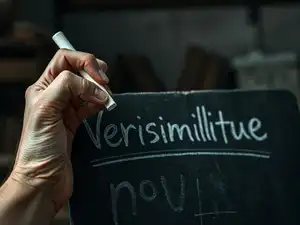
Here's a full article about the word "Verisimilitude," written from scratch, aiming for depth and engaging content:
Word of the Day: Verisimilitude - The Art of Believability
In the vast and intricate tapestry of language, some words carry a weight and nuance that make them particularly potent. Today, we turn our attention to one such word: Verisimilitude. It’s a term that might sound a little formal, even academic, but its meaning is fundamental to how we experience and appreciate much of the world around us, from stories and art to everyday interactions.
At its core, verisimilitude refers to the appearance of being true or real. It's not about outright truth, but rather the likeness to truth. Think of it as a skillful illusion of reality, a crafted credibility that draws us in and allows us to suspend disbelief. The word itself offers a clue to its meaning, derived from the Latin *verus* (true) and *similis* (like or resembling). So, it's the "likeness to truth."
Beyond mere imitation:
It's crucial to understand that verisimilitude isn't simply about making something identical to reality. A perfectly replicated object might be accurate, but it might lack the very essence that verisimilitude aims to achieve. Instead, verisimilitude often involves a careful selection of details, a judicious crafting of context, and an understanding of human psychology to evoke a sense of genuine experience.
Consider the difference between a photorealistic painting and a well-executed Impressionist landscape. The photorealistic painting might be technically accurate, but the Impressionist piece, with its brushstrokes and focus on light and atmosphere, can often evoke a *feeling* of being there, a believable impression of the scene, even if it's not a literal representation. This is verisimilitude at play.
Verisimilitude in action: Where do we find it?
The concept of verisimilitude is deeply embedded in various creative and communicative fields:
* Literature and Storytelling: This is perhaps where verisimilitude is most readily discussed. A novel that achieves verisimilitude doesn't necessarily depict events that *could* happen in our everyday lives. Instead, it creates a world with its own internal logic and consistent rules. Characters act in ways that feel motivated and believable within their given circumstances, even if those circumstances are fantastical. A dragon might breathe fire, but if its motivation for doing so is clearly explained, and its interaction with the world feels grounded, the story possesses verisimilitude. Authors strive for psychological verisimilitude (believable character motivations and emotions) and situational verisimilitude (events that feel plausible within the story's established reality).
* Film and Television: Directors and set designers work tirelessly to create believable environments, costumes, and performances. A historical drama needs to feel authentic to its era, even if minor liberties are taken for narrative flow. A science fiction film might present advanced technology, but its depiction needs to be consistent and understandable to maintain verisimilitude. Even the way actors deliver their lines contributes to this – a performance that feels natural and unforced enhances believability.
* Art and Visual Media: Beyond painting, photography, sculpture, and even video games rely on verisimilitude. A sculptor might aim to capture the lifelike texture of skin, or a video game developer might meticulously recreate the physics of a falling object. The goal is to create an experience that feels "real enough" to engage the viewer or player.
* Journalism and Non-Fiction: While the goal here is truth, the presentation of information often benefits from verisimilitude. Clear, concise language, well-supported evidence, and a logical flow of ideas contribute to the believability of a news report or an academic paper.
* Everyday Communication: Even in our daily conversations, we often judge the verisimilitude of what others are saying. Does their story make sense? Are their reactions consistent with their personality? We unconsciously assess the "likeness to truth" in their accounts.
The power of suspension of disbelief:
Verisimilitude is the silent partner to our willingness to suspend disbelief. When a story or a work of art possesses strong verisimilitude, we are more likely to become engrossed, to connect with the characters, and to be moved by the narrative. It allows us to step outside our own reality and immerse ourselves in another, making the experience more profound and memorable.
Conversely, a lack of verisimilitude can shatter this immersion. If a character acts in a way that is utterly unmotivated, or if the rules of a fictional world are constantly being broken, we are yanked out of the experience, reminded that we are merely observing a construct. This can lead to frustration, boredom, and a sense of being unconvinced.
In conclusion:
Verisimilitude is more than just a fancy word; it's a fundamental principle that underpins our engagement with art, stories, and even our understanding of the world. It's the art of making the unreal feel real, the crafted appearance of truth that allows us to connect, to believe, and to be transported. The next time you find yourself utterly absorbed in a book, a film, or even a compelling anecdote, take a moment to appreciate the skill and intention behind the verisimilitude that has so effectively captured your imagination.