
Politics
धरना-प्रदर्शनों का नया कारोबार: लोकतंत्र की आड़ में आखिर किसके हित साधे जा रहे हैं?
October 10, 2026
1,612 views
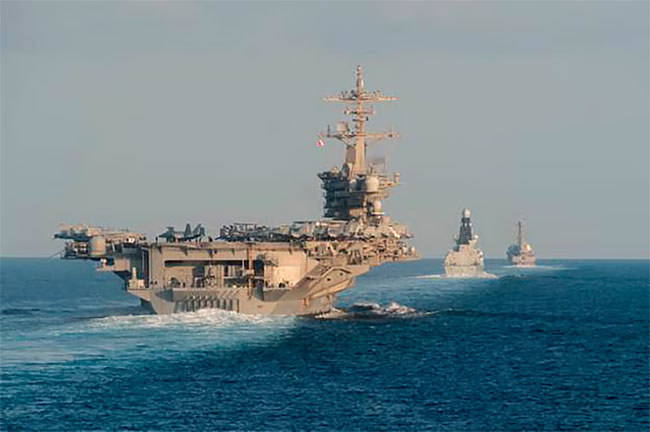
In a notable development in the ongoing tensions in the Middle East, two U.S. warships have successfully transited the Strait of Hormuz. This passage marks the first military maneuver of its kind since the escalation of conflict between the United States and Iran. The transit comes amid heightened concerns over security in this critical maritime corridor, which is pivotal for global oil shipments. President Donald Trump has publicly stated that the United States has initiated efforts to "clear out" the strategic waterway, a statement that underscores the importance of maintaining freedom of navigation in the face of potential threats.
The Strait of Hormuz is one of the most crucial chokepoints in the world, where approximately 20% of the world’s total oil supply passes through. This narrow passageway connects the Persian Gulf with the Gulf of Oman and the Arabian Sea, making it a vital route for oil tankers and commercial vessels. Any disruption in this region can have significant implications for global oil prices and international trade.
Given its strategic significance, the Strait of Hormuz has been a focal point of military and diplomatic strategies for both the United States and Iran. The U.S. Navy regularly conducts operations in the area to ensure that maritime navigation remains unimpeded. However, the recent tensions have led to increased military presence and a more aggressive posture from both nations, with the risk of confrontation looming large.
The ongoing conflict between the U.S. and Iran has its roots in a complex web of historical events, including the U.S. withdrawal from the Joint Comprehensive Plan of Action (JCPOA) in 2018 and subsequent sanctions imposed on Iran. These actions have escalated tensions, leading to confrontations at sea, cyber-attacks, and indirect conflicts in various regional hotspots. Iran has often threatened to block the Strait of Hormuz in response to U.S. sanctions and military presence, leading to heightened military readiness among U.S. forces in the region.
In recent months, incidents involving Iranian vessels and U.S. military assets have increased, with both sides accusing each other of provocative actions. The U.S. has expressed concerns over Iran's attempts to seize commercial vessels, which they view as a direct threat to international shipping and regional stability. The passage of the two warships serves as a clear message of deterrence, reiterating the U.S. commitment to safeguarding the freedom of navigation in the Strait.
Reactions to the U.S. warships' transit have varied across the region. Some Gulf states have welcomed the U.S. presence as a stabilizing force, while Iran has condemned it as an act of aggression. Iranian officials have warned that any perceived threat to their territorial waters will be met with a strong response. These conflicting perspectives highlight the delicate balance of power in the region and the potential for miscalculations that could lead to conflict.
The implications of the U.S. military operations in the Strait of Hormuz extend far beyond the immediate region. Global markets are closely monitoring the situation, as any disruption to oil supply routes can lead to volatility in oil prices and broader economic repercussions. Additionally, the U.S. actions may influence the dynamics of its alliances in the region, particularly with countries that rely heavily on oil exports.
Amid the military posturing, there is a growing call for diplomatic solutions to address the underlying issues fueling the conflict. Many analysts argue that engaging in constructive dialogue with Iran could lead to a de-escalation of tensions and a more stable regional environment. The international community has a role to play in facilitating these discussions, as stability in the Strait of Hormuz is in the interest of all nations dependent on maritime trade.
As the situation continues to evolve, the eyes of the world remain fixed on the Strait of Hormuz. The recent transit of U.S. warships underscores the complexities of U.S.-Iran relations and the precarious nature of Middle Eastern geopolitics. The balance between military readiness and diplomatic engagement will be crucial in the coming months as both nations navigate their paths forward. The global community watches closely, hoping for a resolution that ensures peace and stability in this vital region.
In conclusion, the transit of two U.S. warships through the Strait of Hormuz represents a significant moment in the ongoing tensions between the United States and Iran. As military maneuvers increase in frequency, the potential for conflict looms large. However, the path forward may still be illuminated by diplomacy, which could pave the way for a more peaceful resolution to the challenges facing this strategically vital waterway.


Loading more news...
You've reached the end of our news feed. Check back later for more updates!