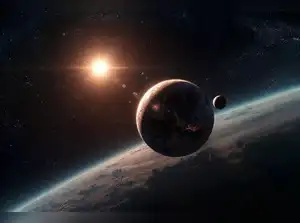
Echoes of Luna: Have We Stumbled Upon Our First Alien Moon?
For millennia, humanity has gazed at the night sky, captivated by the silent ballet of celestial bodies. Our own moon, a constant companion, has shaped our tides, inspired our myths, and served as a stepping stone for our nascent spacefaring ambitions. Yet, beyond our solar system, in the unfathomable expanse of the cosmos, lie untold billions of stars, and with them, the tantalizing possibility of a universe teeming with worlds far stranger and more wondrous than our own. Among these cosmic marvels, the hunt has been on for a particular celestial gem: the exomoon, the moon of a planet orbiting a star beyond our Sun. And now, a whisper from the void, a flicker of evidence, suggests we may be on the cusp of a monumental discovery – the first definitive confirmation of an exomoon.
The candidate at the heart of this burgeoning excitement orbits Kepler-1625 b, a gas giant that dwarfs even our mighty Jupiter, in a distant stellar system. This potential exomoon, if confirmed, would not merely be another astronomical data point; it would be a profound declaration, echoing through the halls of science and igniting the imaginations of generations. It would be tangible proof that the cosmic tapestry is woven with more than just planets and stars, but also with their orbiting companions, a silent testament to the vast, untapped diversity of the universe.
The Long Shadow of Expectation: Why Exomoons are More Than Just a Dream
The quest for exomoons is not a sudden whim born of technological advancement. It is rooted in a fundamental understanding of planetary formation and dynamics, a concept deeply ingrained in our own solar system. Our solar system, a relatively small cosmic neighborhood, hosts an astonishing number of moons. Jupiter alone boasts over 80 known satellites, including four colossal Galilean moons that are themselves worlds of ice and rock, some even harboring subsurface oceans. Saturn, with its iconic rings, also possesses a vast retinue of moons, including Titan, an enigmatic world with a thick atmosphere and liquid methane lakes. Even our terrestrial neighbors, Mars, sport small, captured asteroids as moons.
Given this overwhelming prevalence within our own cosmic backyard, it stands to reason that exomoons would be a common feature throughout the galaxy. If gas giants and rocky planets can form and capture moons here, why not elsewhere? The sheer statistical probability, coupled with our growing understanding of the universe\'s inherent tendencies, fuels the belief that exomoons are not an anomaly, but a fundamental building block of planetary systems.
However, the journey from theoretical expectation to empirical evidence has been a protracted and challenging one. Detecting these celestial phantoms is akin to finding a firefly next to a lighthouse from miles away. The sheer scale of the cosmos presents an immediate hurdle. Exomoons are by definition orbiting exoplanets, which are themselves incredibly faint and difficult to detect. Then, the moon itself is a much smaller, fainter object orbiting an already faint object. The light from the host star, even when dimmed by the transit of its planet, can easily overwhelm the subtle signals of a moon.
A Cosmic Game of Hide-and-Seek: The Ingenuity of Detection
For decades, astronomers have employed increasingly sophisticated methods to probe the distant reaches of the universe for signs of exoplanets. The transit method, which involves observing the slight dip in a star\'s brightness as a planet passes in front of it, has been the most successful. Satellites like Kepler and its successor, TESS, have revolutionized exoplanet discovery by meticulously monitoring the light from hundreds of thousands of stars.
The extension of this method to exomoons is where the real challenge and the true ingenuity lie. While a planet creates a noticeable dip in starlight, a moon transiting *with* its planet would create a more complex, subtle variation in that dip. Imagine a moth flying in front of a streetlamp, and then a tiny gnat flying in front of the moth. The combined shadow is much more intricate than just the moth alone.
The detection of a potential exomoon around Kepler-1625 b relies on precisely this nuanced observation. The Kepler space telescope, known for its prolific exoplanet discoveries, provided the initial dataset. By analyzing the transit light curve – the graph of the star\'s brightness over time – astronomers noticed anomalies that couldn\'t be fully explained by the planet alone.
These anomalies can manifest in several ways:
* Slightly earlier or later transit times: If a moon is gravitationally tugging on its planet, it can subtly alter the planet\'s orbital path, leading to minor shifts in when the transit occurs.
* Variations in transit duration: The presence of a moon could slightly lengthen or shorten the time the planet takes to cross the face of its star, depending on its position relative to the planet during the transit.
* Distortions in the transit light curve: The most telling sign, and the one thought to be present in the Kepler-1625 b system, is a deviation from the expected, smooth dip in brightness caused by the planet. A moon could cause a secondary, smaller dip *within* the main transit, or a more complex shape to the overall dip.
However, interpreting these subtle variations is a monumental task. Several factors can mimic exomoon signals, leading to potential false positives:
* Stellar Activity: Stars are dynamic objects. Flares, starspots, and other phenomena can cause fluctuations in brightness that can be mistaken for exomoon transits.
* Instrumental Noise: Even the most sophisticated telescopes have limitations. Tiny errors or fluctuations in the instruments themselves can introduce noise into the data that mimics a signal.
* Orbital Perturbations: The gravitational influence of other planets in the same system can also affect a planet\'s orbit and transit timing, creating signals that might be misinterpreted.
* The Planet Itself: A planet\'s atmosphere can also play a role. Variations in atmospheric conditions or the presence of rings could potentially create complex transit signatures.
This is why the potential discovery around Kepler-1625 b is so exciting. Multiple observations and rigorous analysis were required to rule out these alternative explanations.
Kepler-1625 b: A System Under Scrutiny
The exoplanet Kepler-1625 b is a world of superlatives. It orbits a Sun-like star approximately 8,000 light-years away in the constellation Cygnus. The planet itself is a \"warm Jupiter\" – a gas giant comparable in size and mass to our own Jupiter, but orbiting much closer to its star. This proximity means it experiences significantly higher temperatures than Jupiter.
The initial discovery of Kepler-1625 b was made by the Kepler Space Telescope, a mission dedicated to finding exoplanets using the transit photometry method. Years of Kepler data were analyzed, revealing the periodic dimming of the star caused by the planet\'s passage. However, it was a subsequent, more detailed analysis, particularly using observations from the Hubble Space Telescope, that brought the possibility of an exomoon into sharp focus.
The Hubble observations were crucial because they offered higher precision and a more detailed view of the transit light curve. The team of astronomers, led by Thomas Zurbuchen (then Associate Administrator for NASA\'s Science Mission Directorate) and his colleagues, meticulously examined the data. They observed a transit that was not only slightly longer than predicted but also appeared to have a slight \"hump\" or distortion in its profile.
This distortion, they argued, could be explained by a moon, roughly the size of Neptune, orbiting Kepler-1625 b. The proposed exomoon, provisionally named Kepler-1625 b I, would be a colossal entity in its own right. For context, Neptune is the third-largest planet in our solar system. An exomoon of this magnitude would be unprecedented and would redefine our understanding of what constitutes a moon.
The researchers proposed a scenario where both the planet and its massive moon transited the star. The initial dip in starlight would be caused by the planet, and then, as the moon followed, a secondary, shallower dip would be observed. Alternatively, the gravitational pull of such a large moon could be subtly influencing the planet\'s orbit, causing the observed deviations in transit timing and duration.
However, the scientific community, rightly, approaches such extraordinary claims with extreme caution. The statistical significance of the signal was not yet at the level required for definitive confirmation. The paper published detailing these findings emphasized that while the data was \"suggestive,\" it was not conclusive. The possibility of other, more mundane explanations, such as the planet\'s atmospheric properties or the presence of a complex ring system, could not be entirely ruled out.
The Stakeholders in the Search for Cosmic Companions
The search for exomoons involves a diverse cast of characters, each with their own motivations and contributions:
* Astronomers and Researchers: These are the frontline investigators, designing telescopes, developing detection algorithms, analyzing vast datasets, and publishing their findings. Their driving force is the insatiable curiosity to understand our universe and our place within it. They are the meticulous detectives piecing together cosmic puzzles.
* Space Agencies (NASA, ESA, etc.): These organizations fund and operate the sophisticated instruments, like the Kepler and Hubble telescopes, that make these observations possible. They are the enablers, providing the technological backbone for the scientific endeavor. Their role is to push the boundaries of human exploration and knowledge.
* Technological Innovators: The development of new, more sensitive telescopes and advanced data processing techniques is crucial. Companies and engineers involved in optics, sensor technology, and software development are vital to advancing our ability to detect fainter signals from greater distances.
* The Public and Science Enthusiasts: The excitement generated by potential discoveries like this fuels public interest in space exploration and science. This broad support can translate into political will for funding and inspire the next generation of scientists.
* Philosophers and Theologians: The confirmation of exomoons would have profound philosophical implications, prompting discussions about the uniqueness of life, the prevalence of complex planetary systems, and our place in the grand cosmic scheme.
* Science Fiction Writers and Artists: These individuals often anticipate and popularize the implications of scientific discoveries, igniting the public imagination and exploring the possibilities of alien worlds and life beyond Earth.
A Chronology of the Quest: From Theory to Tentative Triumph
The journey towards detecting exomoons has been a gradual evolution, marked by theoretical advancements and technological leaps:
* Early Speculation (Pre-1990s): Even before the first exoplanet was confirmed, astronomers theorized about the existence of planets and moons around other stars, based on the principles of celestial mechanics and observations within our own solar system.
* The Exoplanet Revolution (1990s onwards): The confirmation of 51 Pegasi b in 1995 marked the dawn of the exoplanet era. As thousands of exoplanets were discovered, the focus naturally broadened to their potential satellites.
* Theoretical Frameworks for Exomoon Detection (2000s onwards): Researchers began developing the theoretical underpinnings for how exomoons might be detected, refining transit photometry techniques and exploring other potential methods like radial velocity variations and direct imaging.
* The Kepler Mission and the Transit Method (2009-2018): Kepler\'s unprecedented precision and long observation period revolutionized exoplanet discovery. While primarily designed for planets, its data held the potential for exomoon signals.
* Early Candidate Claims (Mid-2010s): Several tentative exomoon candidates began to emerge from the Kepler data, often involving planets with unusual transit light curves or orbital dynamics. These early claims, while exciting, were often met with skepticism due to the difficulty in ruling out other explanations.
* The Hubble Observations of Kepler-1625 b (Mid-2010s onwards): The use of the more powerful Hubble Space Telescope to re-examine specific exoplanet systems, like Kepler-1625 b, provided the enhanced resolution needed to identify subtle anomalies in transit light curves.
* Publication of the Kepler-1625 b Exomoon Candidate (2018): A landmark paper announced the strong possibility of an exomoon around Kepler-1625 b, based on detailed analysis of Kepler and Hubble data. This was arguably the most compelling candidate to date.
* Ongoing Follow-up Observations and Refinements (Present): The scientific community continues to scrutinize the Kepler-1625 b system. Future observations with even more advanced telescopes are planned to gather further evidence and potentially confirm or refute the exomoon hypothesis.
A Glimpse into the Future: What a Confirmed Exomoon Means
The confirmation of an exomoon around Kepler-1625 b would be a watershed moment in astronomy, with far-reaching implications:
* Redefining Planetary System Architectures: The existence of such a massive moon would challenge our current models of planet formation and evolution. It could suggest that the formation of large moons is a more common or robust process than previously thought, even around very massive planets.
* The Potential for Habitable Moons: While Kepler-1625 b is a gas giant, the discovery of its exomoon opens the door to the possibility of smaller, rocky moons around other exoplanets. If these moons orbit within the habitable zone of their star – the region where liquid water could exist on the surface – they could potentially harbor life. Imagine a moon like Europa or Enceladus in our own solar system, but orbiting a distant star.
* New Avenues for Astrobiology: The search for extraterrestrial life has largely focused on exoplanets. The discovery of exomoons would expand this search to a new class of celestial bodies, potentially increasing the number of targets where life could arise. Astrobiologists would be eager to study the atmospheric composition, geological activity, and potential for subsurface oceans of any confirmed exomoons.
* Technological Advancements and the Next Generation of Telescopes: The challenges inherent in exomoon detection will drive the development of even more sensitive telescopes and innovative observational techniques. The James Webb Space Telescope (JWST) is already poised to play a crucial role in characterizing exoplanet atmospheres. Future missions could be specifically designed to detect exomoons with even greater certainty. Ground-based Extremely Large Telescopes (ELTs) will also offer unprecedented power for exomoon hunting.
* Inspiration and Public Engagement: The confirmation of an exomoon would undoubtedly capture the public imagination, sparking a renewed interest in space exploration and scientific discovery. It would be a tangible reminder of the vastness and complexity of the universe, inspiring awe and wonder.
* A Shift in Our Cosmic Perspective: For centuries, our understanding of the universe has been centered on our own solar system. The confirmation of an exomoon would be a definitive step towards understanding the commonality of features we take for granted, suggesting that the universe is not only vast but also familiar in its fundamental building blocks.
However, the path to confirmation is paved with continued observation and rigorous scientific scrutiny. Future observations with telescopes like the JWST will be critical. These instruments can analyze the light passing through an exoplanet\'s atmosphere during a transit, providing clues about its composition. If the exomoon hypothesis is correct, subtle differences in the transit signal observed by JWST could further strengthen the case.
Furthermore, the development of new algorithms and statistical methods to analyze exomoon transit data will be essential. The scientific community must remain vigilant against confirmation bias and ensure that any announced discovery withstands the most stringent scientific testing.
Conclusion: The Dawn of a New Cosmic Era
The search for exomoons has moved from the realm of theoretical curiosity to the precipice of groundbreaking discovery. The tantalizing hints emanating from the Kepler-1625 b system, amplified by the capabilities of the Hubble Space Telescope, have brought us closer than ever to confirming the existence of these elusive celestial bodies.
If confirmed, the discovery of Kepler-1625 b I would be more than just an astronomical footnote; it would be a profound testament to the universal nature of celestial mechanics and a powerful indicator of the sheer diversity of planetary systems that populate our galaxy. It would open up new frontiers in the search for habitable worlds, expand our understanding of planet formation, and ignite the imaginations of people across the globe.
The universe, it seems, is even more enchanting and complex than we dared to dream. The search for alien moons is a journey into the unknown, a testament to human ingenuity and our enduring desire to comprehend our place in the cosmos. As we continue to refine our tools and hone our observational techniques, the echoes of distant moons – the exomoons – are growing louder, promising to reveal a universe teeming with wonders yet to be discovered. The search for an exomoon might not just be about finding a single celestial body; it might be about finding a new chapter in our understanding of the universe itself.