The Accidental Oracle: How a Neglected Petri Dish in Alexander Fleming\'s Lab Ushered in the Antibiotic Revolution and Echoed Warnings of Future Peril
The tapestry of scientific progress is often woven with threads of meticulous planning and deliberate investigation, yet it is also remarkably punctuated by moments of serendipity – unexpected observations that, in the hands of insightful minds, unlock entirely new paradigms. Among these transformative accidents, few are as profoundly significant as the one that unfolded in a cluttered London laboratory in the late summer of 1928, within the confines of a humble petri dish. This unassuming vessel, seemingly abandoned amidst the usual detritus of bacteriological research, held within its glassy walls the nascent spark of a revolution that would forever alter the course of human medicine: the antibiotic revolution, ignited by the discovery of penicillin.
The story begins with Sir Alexander Fleming, a Scottish physician and bacteriologist, whose laboratory at St. Mary\'s Hospital in London was a hub of scientific inquiry, albeit one characterized by a certain charming disarray. Fleming was not a man of pristine workspaces; his colleagues often noted his propensity for leaving his experiments unattended for extended periods, a habit that, while frustrating to some, would prove to be the very catalyst for his monumental discovery. He was, at the time, engaged in research on *Staphylococcus*, a bacterium notorious for causing a range of infections, from minor skin ailments to life-threatening conditions like pneumonia and meningitis.
Fleming’s approach to his work was characterized by a keen observational power, a capacity to see what others might overlook. He possessed a deep understanding of the microscopic world he studied, and his mind was constantly seeking patterns and anomalies. It was this very characteristic that would set him apart when, after returning from a holiday in August 1928, he began the tedious task of sorting through his accumulated petri dishes, many of which had been left out while he was away.
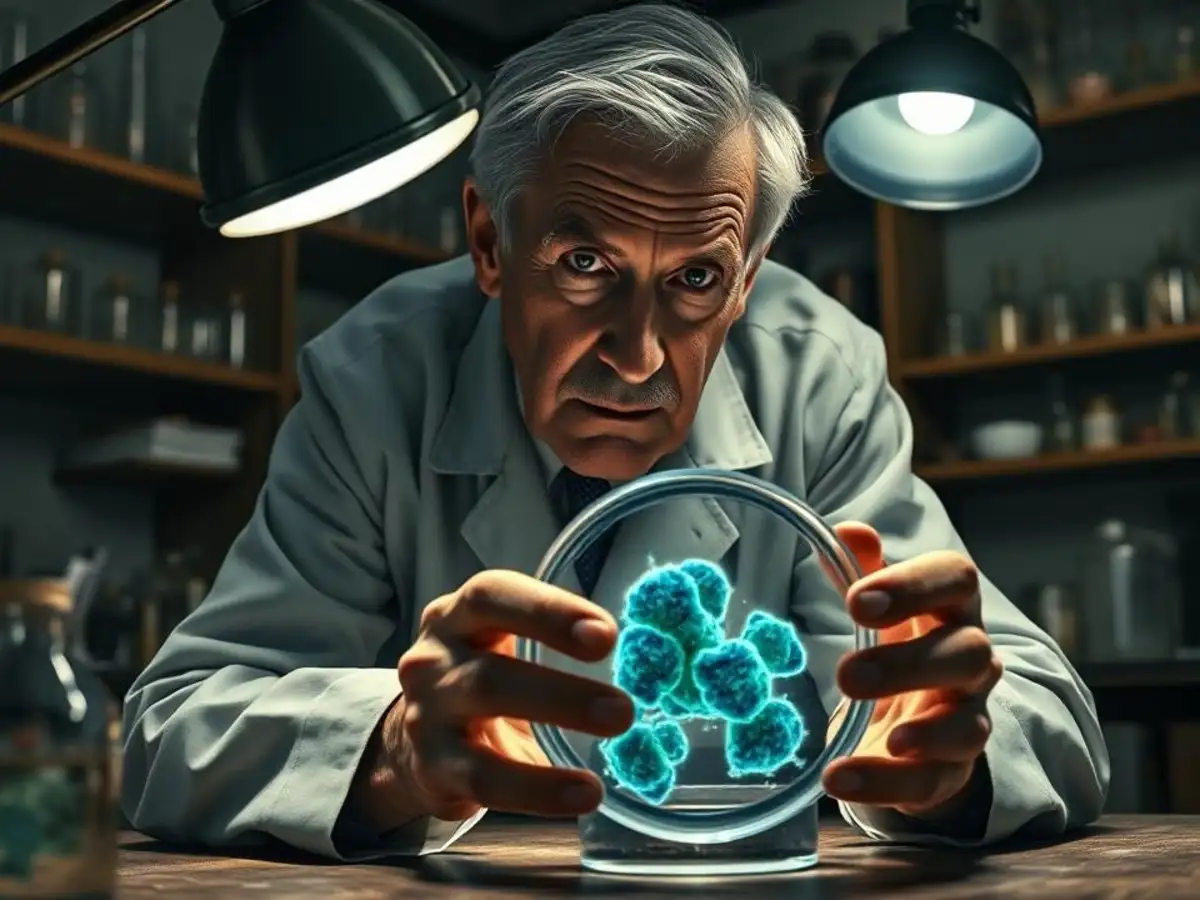
As Fleming picked up a dish that had been contaminated with mold, an unexpected sight arrested his attention. The petri dish, intended to cultivate *Staphylococcus* colonies, presented a stark and compelling contrast. Where the mold had spread, the bacteria had been annihilated. A clear halo, a zone of inhibition, surrounded the errant growth, a testament to the mold\'s potent antibacterial power. This was not merely an observation of contamination; it was a profound revelation. The mold, which he later identified as *Penicillium notatum*, was actively producing a substance that was lethal to the deadly bacteria he was studying.
Fleming, with his characteristic pragmatism and scientific rigor, did not dismiss this as a mere laboratory curiosity. He recognized its immense potential. He isolated the mold, cultured it, and extracted the active substance, which he tentatively named \"penicillin.\" His initial experiments, documented in his laboratory notebooks and later published in the *British Journal of Experimental Pathology* in 1929, demonstrated penicillin\'s remarkable ability to kill a wide range of pathogenic bacteria in vitro, while appearing to be non-toxic to human cells. He noted its effectiveness against bacteria responsible for scarlet fever, pneumonia, meningitis, and diphtheria, diseases that were at the time significant killers.
However, the path from discovery to widespread application was far from immediate. Fleming, a brilliant scientist, was not necessarily an adept chemist or a master of large-scale production. He struggled to isolate and purify penicillin in sufficient quantities for effective therapeutic use. The substance proved to be unstable and difficult to extract, and Fleming’s initial attempts to develop it into a practical medicine were met with significant challenges. He recognized its potential but lacked the resources and the chemical expertise to overcome these hurdles. While he published his findings, the scientific community, for the most part, did not grasp the full significance of his discovery, and penicillin remained a laboratory curiosity for over a decade.
The true dawn of the antibiotic era, the transformation of Fleming’s serendipitous observation into a life-saving drug, would await the dedicated efforts of a team of scientists at Oxford University during the harrowing years of World War II. Howard Florey, a pathologist, and Ernst Chain, a biochemist, along with their colleagues Norman Heatley and others, revisited Fleming’s work in the late 1930s. Driven by the urgent need for treatments for battlefield infections, they embarked on a systematic and arduous quest to purify and mass-produce penicillin.
Florey and Chain, armed with more advanced chemical techniques and a relentless determination, managed to isolate and purify penicillin in a more stable form. Their early experiments on mice, infected with lethal doses of bacteria, were nothing short of astonishing. Mice treated with penicillin survived, while the control group succumbed to infection. This unequivocal demonstration of penicillin\'s efficacy in a living organism was a watershed moment.
The challenge then shifted to scaling up production. The United Kingdom, embroiled in war, lacked the industrial capacity for mass production. Florey, recognizing the urgency and the potential, traveled to the United States in 1941, seeking assistance from American pharmaceutical companies. This collaboration, spurred by the exigencies of war, proved to be the crucial turning point. American industry, with its vast resources and manufacturing capabilities, was able to develop methods for large-scale fermentation and purification of penicillin. By 1944, penicillin was being produced in sufficient quantities to treat Allied soldiers wounded in the D-Day landings, saving countless lives and significantly reducing the mortality rate from battlefield infections.
The impact of penicillin on medicine was nothing short of revolutionary. Prior to its advent, bacterial infections were a major cause of death and disability. Diseases like pneumonia, tuberculosis, sepsis, and syphilis, which are now often treatable with a course of antibiotics, were frequently death sentences. Surgical procedures, even relatively minor ones, carried a significant risk of post-operative infection, often leading to fatal complications. Childbirth was also a perilous undertaking, with puerperal fever, a severe infection of the reproductive tract, claiming the lives of many mothers.
Penicillin changed all of this. It offered a powerful weapon against a vast array of bacterial pathogens. For the first time in history, physicians had a reliable means to combat infections that had plagued humanity for millennia. The mortality rates for bacterial pneumonia plummeted. Infections that once led to amputation or death could now be cured. The development of antibiotics transformed the landscape of healthcare, making previously dangerous medical interventions, such as complex surgeries and organ transplants, significantly safer. The advent of penicillin marked the beginning of the \"golden age of antibiotics,\" a period of unprecedented progress in combating infectious diseases.
Fleming\'s discovery, initially a humble observation in a petri dish, had thus blossomed into a global medical miracle, profoundly impacting the lives of billions. His solitary insight, amplified by the dedication of others, had unlocked a new era of human health and longevity. The story of penicillin is a testament to the power of observation, the importance of scientific collaboration, and the transformative potential of even the most unexpected discoveries.
However, the narrative of Alexander Fleming and his forgotten petri dish is not solely a tale of triumph. It also carries within it a prescient warning, a somber echo that resonates with profound relevance even today: the challenge of antibiotic resistance. Even in his initial investigations, Fleming observed that if the concentration of penicillin was too low, the bacteria could develop resistance to its effects. He noted that bacteria could become \"acclimatized\" to penicillin, and that some strains were inherently less susceptible.
Fleming himself, in his Nobel Prize acceptance speech in 1945, articulated this concern, stating, \"The time may come when penicillin can be bought by anyone in the shops. Then the ignorant man may easily become a victim of the drug by taking it blindly, thus rendering himself immune against the penicillin. There is the danger, also, that the ignorant man may easily become a carrier of the bacteria that has become resistant to penicillin.\"
This warning, seemingly understated at the time, was remarkably prophetic. The widespread and sometimes indiscriminate use of penicillin, and subsequently other antibiotics, created an evolutionary pressure on bacteria. Those bacteria that possessed genetic traits allowing them to survive or evade the effects of antibiotics were more likely to reproduce, passing on their resistance genes to their offspring. Over time, this led to the emergence of \"superbugs\" – bacteria that are resistant to multiple antibiotics, rendering previously effective treatments useless.
The overuse and misuse of antibiotics in human medicine, agriculture, and veterinary practices have accelerated this phenomenon. In many cases, antibiotics have been prescribed for viral infections, against which they are ineffective, contributing to unnecessary exposure and selection for resistant strains. In agriculture, antibiotics have been used to promote growth and prevent disease in livestock, creating reservoirs of resistant bacteria that can potentially spread to humans.
Today, antibiotic resistance is a global health crisis. The World Health Organization has declared it one of the top 10 global public health threats facing humanity. Infections that were once easily treated are becoming increasingly difficult, and in some cases impossible, to manage. This threatens to unravel many of the medical advancements made possible by the antibiotic revolution. Complex surgeries, cancer chemotherapy, organ transplantation, and care for premature infants all rely on the availability of effective antibiotics to prevent and treat infections. As resistance grows, these vital medical procedures become increasingly risky.
Fleming\'s initial insight into penicillin was a double-edged sword. While it provided humanity with an unprecedented tool to combat bacterial infections, it also inadvertently initiated an arms race between humans and bacteria. The very success of antibiotics created the conditions for resistance to emerge. Fleming’s foresight in recognizing this potential danger underscores his profound scientific acumen. He not only discovered a miracle drug but also, perhaps unintentionally, provided an early warning of the enduring challenge that would define the latter half of the antibiotic era.
The story of Alexander Fleming’s forgotten petri dish is therefore not merely a historical anecdote; it is a compelling narrative that continues to unfold. It is a story of brilliant observation, dedicated research, and transformative impact. It is a story that reminds us of the incredible power of scientific inquiry to alleviate human suffering and extend lifespans. But it is also a cautionary tale, a stark reminder of the delicate balance of nature and the critical importance of responsible stewardship of the powerful tools we develop.
The legacy of Fleming’s discovery compels us to reflect on our current relationship with antibiotics. It calls for a renewed commitment to antibiotic stewardship – the judicious and responsible use of these precious drugs. This involves educating healthcare professionals and the public about appropriate antibiotic use, developing new diagnostic tools to identify bacterial infections accurately, investing in the research and development of new antibiotics and alternative therapies, and promoting infection prevention and control measures to reduce the overall need for antibiotics.
In conclusion, the forgotten petri dish in Alexander Fleming\'s London lab in 1928 was far more than just a serendipitous accident. It was the germination point of a medical revolution that saved countless lives and fundamentally reshaped human health. From its humble beginnings, penicillin blossomed into a life-saving drug, transforming treatments for infections, making surgeries and childbirth safer, and ushering in an era of unprecedented progress against bacterial diseases. Yet, woven into this remarkable narrative is Fleming\'s prescient insight into the insidious threat of antibiotic resistance, a challenge that continues to loom large today. The ongoing struggle against resistant bacteria serves as a constant reminder that the legacy of Fleming\'s discovery is not just about the power of a single molecule, but also about the enduring responsibility of humanity to harness that power wisely, ensuring that the antibiotic revolution, ignited by a chance observation, continues to serve us for generations to come, rather than succumbing to the very forces it unleashed. The echo from that neglected petri dish serves as both a beacon of hope and a clarion call for vigilance.